Showing posts with label Roald Dahl. Show all posts

Tuesday, 14 May 2024

Where do I come from? (part 2) by Lynne Benton

Last month I wrote about the origins of five famous children’s books.  I was fascinated to discover what inspired the writers to come up with such long-lived classics, and I hope some of you were equally interested.

Anyway, as promised, today I want to go on with five more famous children’s books and/or series.

The first of these is Mary Poppins, by P L Travers, published in 1934.


P L Travers’ creation, unlike her screen portrayal, is a “fierce, witchy heroine who imparts the deeper meaning of life to her charges.”  Travers moved among mystics and magicians, such as AE Russell (a writer on mysticism), WB Yeats, (as well as being a poet, he was a devotee of Irish mythology and folklore) and GI Gurdjieff, (a Russian philosopher, mystic and spiritual teacher) from whom she soaked up mythology and esoteric lore.  Mary, blown in on the east wind, is more of a shaman than an Edwardian nanny, able to understand the language of animals and stars and coming “from the Dark where all things have their beginnings”.  So forget Julie Andrews, then!  No wonder Travers was less than enthusiastic about Disney’s interpretation of her books!  (Though no doubt many more children have become attracted to the books purely because they enjoyed the film so much.  And anyone who saw the film "Saving Mr Banks", starring Emma Thompson as P L Travers, will have a little more idea of the origins of the books.)

Next comes The Chronicles of Narnia, by C S Lewis, published in 1950.


In their middle-class Belfast home, Jack Lewis and his elder brother Warnie enjoyed sibling camaraderie in their nursery, presided over by a large wardrobe.  Jack, obsessed by Beatrix Potter’s books, created stories about anthropomorphic animals.  In depressed middle age, Lewis, now an Oxford don, finally found a way through the wardrobe doors to the Christian allegory that lay beyond.  (For a great deal more about all the Narnia books, do read Katherine Langrish’s lovely book “From Spare Oom to War Drobe.”)

And now for three more recent books:

The first of these is The BFG, by Roald Dahl, published in 1982.


He’s bald, nobbly, scary, extremely tall and has a way with words.  He carries off children, at least Sophie, to an unknown land.  He turns out to be warm, funny and protective.  The BFG is Dahl himself, and Sophie his real-life granddaughter.  The land of giants derives from the Norse myths related by Dahl’s Norwegian mother.

Next, as if I could leave it out, is Harry Potter by J.K.Rowling.  The first book in the series of seven, Harry Potter and the Philospher’s Stone, was published in 1997, and of course, as we all now know, it created a publishing phenomenon.


Rowling says “Harry strolled into my head fully-formed”, though it’s possible to glimpse a touch of Sherlock Holmes about him. She also says that Hermione is a caricature of herself at the age of eleven, and that Ron Weasley resembles a best friend from sixth form.  Her rich vocabulary has classical and mediaeval sources: Dumbledore is Middle English for bumblebee, while Muggles is jazzspeak for marijuana.

And finally, Artemis Fowl by Eoin Colfer, published in 2001.


This is described by its author as “Die Hard with fairies”.  The story of the teenage criminal mastermind is also indebted to Hill Street Blues, and also to “all the leprechauns the Irish author has grilled”.


And that’s the end of my ten books/series and their origins.  I hope you’ve found it as interesting as I did when I first read about what inspired the writers to write their famous books. 

Website: lynnebenton.com


Thursday, 9 March 2023

Oh no, not more about Dahl? Not exactly... Anne Rooney

"Times were tough. It hadn't rained for years. There was nothing in the garden except one small cabbage and a stick of celery. Little Else and her grandmother were so poor they only had dinner once a week. They were so thin they had to walk over the same ground twice to throw a shadow."
Little Else, Trick Rider, Julie Hunt, 2010

This isn't funny any more. Was it funny in 2010? With distance from the kind of poverty that now surrounds us, perhaps it was — except for the poor children. (It's not as though there weren't any poor children in 2010.) A third of children in the UK now live in poverty. A third of children might find this making fun of their plight uncomfortable.

How do we read children's books from the past, even the very recent past? Should we change them to match modern lives and sensibilities? If we choose to change them, which things should we change? It seems the recent Dahl edits, and the slightly more distant Blyton edits, tinker at the edges but don't seem to have any recognisable parameters within which change is effected. In 2010, Hodder changed some of Blyton's books, often in rather pointless ways. Few children couldn't understand 'mother and father' — and it wasn't changed to the gender neutral 'parents', but to 'mum and dad' — the preferred terms of middle-class southerners replacing the old-fashioned but generic terms. The change of 'dirty tinker' to 'traveller' was more sensible. Travellers and their children have a hard enough time without children's books condoning and contributing to casual abuse. 

Removing directly offensive terms targeted at groups who haven't chosen the characteristic being mocked or derided is not at all the same as pandering to a kind ahistorical insensibility about language. I'm reading The Little White Horse (Elizabeth Goudge, 1946) with MB at the moment. I often have to stop to explain a word, or a concept. Yesterday's session led to a discussion of how children's lives have changed over the last 50 years. Children need to learn that times change, language changes, behaviour and ideas change. Some behaviour and ideas in the past would now be considered inappropriate. But some ideas and behaviour now are inappropriate, and condoned. We've just had a Prime Minister who referred to Muslim women as 'letter boxes'. Women peacefully holding a vigil after the murder of another woman by a police officer were ill-treated and prosecuted. The current government wants to send people fleeing war zones to Rwanda. I don't think sanitising the past is a priority. (Though of course it might serve the right-wing nostalgia for a little England where everything was rosy.) We aren't preparing children for life in the present by refusing to keep words like 'plump' in books from the past. The issue of whether to use the word in a new book is, to my mind, separate. 

If we are going to change books from the past, I would propose that we set clear parameters (and say 'modernized' on the cover, quite clearly). Those parameters should be about directly caricaturing, ridiculing or bullying characters on the basis of characteristics they can't help. That ridiculing or bullying should be on the part of the narrator/author, not a character in the book who might be being shown in a bad light through their treatment of others. So if character A calls character B a fat slob, that's not the same as the narrative introducing character B as a fat slob. The second endorses criticism of being overweight and inactive. The first sets up character A for a downfall, discovery, revenge, or whatever. 

We need nuance and parameters. And then we need to discuss whether it impinges on the moral rights of a dead author to make changes they would not have wanted. We might need a test case. Moral rights continue for the duration of copyright and, most importantly, can't be assigned to someone else. So although Netflix have the copyright in Dahl's work, can they violate his moral rights?

Friday, 24 February 2023

ON DAHL AND AUGUSTUS GLOOP, by Saviour Pirotta

 When readers ask me why I think historical fiction is important, my standard and honest reply is 'because we have to know the past to understand the present and shape our future.'

    I'm saying this because I have been following the public debate about Puffin's 'retouching' of Roald Dahl's books to make them more acceptable to modern audiences. As I'm sure all followers of this blog know, Penguin hired 'sensitivity readers' to remove language from his work that they think stigmatise people. Many have come out against this decision, and I am against it too, but for different reasons mostly quoted in the press.  


    One of the big changes is apparently calling Augustus Gloop in CATCF 'enormous' instead of 'fat', even though 'enormous' is still a negative label. At least is hasn't got the guilt associated with 'fat'. As someone who's been fat-shamed most of his life, I abhor that label. At school, it followed me around like a vindictive, whispering harpy, crushing what little self-confidence I had, even - I have to admit - driving me to suicidal thoughts at one point. Dahl was not popular in my country of origin when I was growing up. But there was a very similar character in our Italian primer called Pappo il Mangione, Pappo the Big Eater. In the illustrations he looked very much like Billy Bunter, forever stuffing his face, unable to stop binge eating. More often than not, he was shown with his shirt buttons rocketing off his fat belly. I lived in fear of the same thing happening to me and spent years sitting with my back straight and my tummy sucked in case the buttons flew off my school shirt.

    Words are might powerful things, and when they're given legitimacy by an author, in a book, that power is multiplied ad infinitum. The printed page gives them validity and acceptance. We teach kids to admire and look up to writers. If it's ok for them to label someone fat, why shouldn't the kids? 

    After that little rant, you must be wondering by now why I don't support the changes to Dahl's books. The reason is because Dahl wrote those horrible descriptions. He thought it legitimate to put them down on paper. They were a reflection of his world view, and his readers of the time found them acceptable. Millions still do. No amount of tinkering with text is ever going to change that. 

    Thankfully the world of books (and telly, art and films) is moving on from the likes of Roald Dahl and his privileged ilk (David Walliams, John Cleese etc). There's a plethora of books whose authors choose to celebrate the vibrant rainbow that make up humanity rather than sneer at anyone who's different. Let Dahl and his work be a testament to a world we are hopefully leaving behind. We have to know our past to help shape our future.

    Saviour Pirotta is the author of THE GOLDEN HORSEMEN OF BAGHDAD for Bloomsbury and the WOLFSONG and THE NILE ADVENTURES series for Maverick. Follow him on twitter @spirotta and on instagram @saviour2858.


Friday, 4 May 2018

When children's writers write about neglect and drugs – David Thorpe

Last weekend my nearby town Llandeilo hosted a LitFest and, as part of it, I went to see Wendy White, a fellow member of the Welsh branch of the Society of Children's Book Writers and Illustrators.


Is this Wendy White - or Sara Gethin?

Wendy has had a few children's books published, but she wasn't there to talk about one of those. Instead she has had a book for adults published – but under the pseudonym.

She won't mind if I tell you that her identity in this guise is Sara Gethin (who has a completely different website from Wendy). Her publisher, Honno, decided to take this move to prevent children who follow her work from picking this book up and reading something they might find upsetting.


This is because the book, Not Thomas, is written from the point of view – and therefore in the simple language – of a five year-old child and consequently could seem like it is written for young children.

If you haven't yet read it, I do recommend it, but it makes uncomfortable reading, as you quite quickly realise that the boy is neglected by his single parent mother who is a drug addict.

The boy himself, of course, doesn't yet know this.

It got me wondering how common it is that children's writers who also write for adults take steps to protect their young readers in this way. I don't know of any others, do you?

Roald Dahl, for example, wrote some pretty scary stories for grown-ups under the same name.


Perhaps it is because Wendy writes for especially young children rather than the middle grade or older children who form most of Dahl's young audience.

Wendy took over 10 years to write this book, often writing huge chunks of it in her head and keeping it there for weeks before writing them down. She was a primary school teacher in deprived areas of south Wales, and that's where she found her material and her inspiration.

At her session, whose topic was writing about dysfunctional families, Wendy divulged that she is frequently invited to do work in prisons around Not Thomas, where she was initially afraid of what inmates would think about her book.

She discovered that many of them found it highly affecting, forcing them to recollect their own childhoods, which had been not dissimilar from poor Thomas'.

She recounted that one of the prisoners said he had a child on the outside who was being raised by a single mother, and she asked him what this child's life was like. The man replied, pretty much like in the book. It's heartbreaking.

Children of addicts and alcoholics often grow up to have real problems of their own and frequently do end up in prison. Unfortunately we are in the middle of an epidemic of drug addiction, with gangs of children often being used to supply the drugs and getting involved in turf wars.

Perhaps writers who care about these things need to get out more into these communities to use their particular communication skills to help these kids, just like Wendy.

Saturday, 3 September 2016

The BFG (a review of the film) by Sharon Tregenza


Note: In case anyone doesn't know Roald Dahl's "BFG" - Beware spoilers.


Last weekend I took my grandchildren to see The BFG. I was excited. I mean, a combination of Roald Dahl, Steven Spielberg and Mark Rylance? That sounded like a Holy Trinity to me.

It starts well.


Moody and mystical and set in a pseudo-Victorian London complete with spooky orphanage. The BFG disguised himself against the buildings in the shadows of a swirling fog. And then there was that terrifying moment when the giant hand comes in through the window, plucks Sophie from her bed and runs off with her.

But then, but then...


The film slows almost to a stop. We were in the land of dreams for far too long. It was beautiful with plenty of swirly lights and colours, but there was too much dialogue and I found myself nodding off (although to be fair a family gathering with plenty of wine the night before may have had something to do with that).

Except it wasn't just me. There was general squirming and fidgeting from the children in the audience and the volume of soft-drink slurping and sweet paper crackling rose considerably.

I think they missed a trick with the dream thing too. There was one sequence with a boy who talked to the president on the phone, but it felt incidental and was instantly forgettable. Dreams and CGI? What a gift. They could have done so much with that.


It was left to the last act to jolt everyone out of their stupor. And it did. A right royal farcical piece set in a modern day Buckingham Palace. The Queen of England, and her corgis, farting gloriously after drinking the BFG's fizzy "frobscottle" was a great success. There was laughter in the cinema for the fist time.

I think Speilberg's BFG was flawed, but charming in parts. Perhaps too long an adaptation of a slender book. Mark Rylance was brilliant and lit up the screen with his huge CGI smile and Ruby Barnhill is a perfect Sophie.


My grandchildren enjoyed it. Or at least they said they did. Thinking about it now, they may well have been humouring me because I wanted so much for them to like it. It's the sort of thing they would do. :)


Wednesday, 3 August 2016

THE BIG FRIENDLY READ by Sharon Tregenza


I signed up at my local library as a volunteer for the Summer Reading Challenge. Every year, thousands of families all over the country take part in this event which is run by the charity:
The Reading Agency.

It's a challenge to get children reading during the summer holidays. There's a different theme each year. As 2016 marks 100 years since the birth of Roald Dahl this year the focus is on his gloriumptious stories and squiffling  characters.


It's for children aged four to eleven and it's completely free. They read a total of six books, chat to a volunteer about them, and win rewards.

What I didn't expect was for it to be so much fun. I've a way to go yet, but already I've had the pleasure of listening to some entertaining comments from the kids.


For instance:

Me: So, if you found a hippo in your bed how would you get it to move?
8 yr old: I could get a shovel and smash its head in and kick it out.
Me: Umm, maybe there's a nicer way?
8 yr old: I could make a cloud and make it rain food-like spaghetti. Then I could make a trail with the spaghetti to lead it outside to my neighbour's garden.
Me: Do you think your neighbour would be happy to have a hippo in the garden?
8 yr old: Well, they've got a paddling pool.


And:
10 yr old after reading a book about Minecraft.
Me: Minecraft. That's a video game, isn't it?
10 yr old. Yeah.
Me: What's the game about?
10 yr old: You mine stuff and you craft stuff.


Looking forward to next week's reviews.  J


Find out more about The Big Friendly Read


sharontregenza@gmail.com


Sunday, 3 April 2016

RITUALS AND SUPERSTITIONS by Sharon Tregenza

I bought this small glass finch recently because my WIP is a mystery about songbird trapping.


It's a superstition of mine to have something relevant as a focal point, a touchstone, near me as I write.

It made me wonder how many well-known authors did something similar - engaged in rituals or superstitions. We know about Roald Dahl's messy garden hut and his preference for writing in HB pencil on yellow paper, but compared to some, Dahl was Mr Normal.


Roald Dahl at work in his hut.


A quick google threw up some doozies.

British poet Edith Sitwell would take a rest in an open coffin before writing. She said it helped her focus and cleared her mind.


Edith Sitwell

Truman Capote had several superstitions: he wouldn't begin or finish a piece of work on a Friday, he'd refuse a hotel room if the number involved a 13 and he always left precisely three cigarette butts in his ashtray even when this meant tipping the rest into his coat pocket.


Truman Capote


Fredrich Sciller needed the smell of rotten apples to inspire him (he kept them hidden in his desk drawer). Joaquin Miller took things a whole step further - convinced he couldn't write without the sound of rain on his roof he installed a sprinkler system to continuously pour water over his house. Alexander Dumas insisted on writing fiction on blue paper, poetry on yellow and his articles on pink.

And, like many sports fans with their their "lucky" jerseys James Joyce wore a special white coat to work in.


James Joyce in his "lucky" white coat.

Next to these, my glass finch seems a small indulgence.


Sunday, 17 January 2016

Getting Rid of Mum: Books With Single Parent Dads in Children's Fiction - Emma Barnes


I wasn't sure why I created a family without a mother when I wrote Wild Thing. I've nothing against mothers. I've a very nice one of my own. Many of my best friends are mothers. Not to put too fine a point on it, I AM a mother. It wasn't something I thought about at the time. Kate and Wild Thing just didn't happen to have a mum. They had a dad looking after them instead.
interior from Wild Thing Gets A Dog - copyright Jamie Littler


I think a lot of the reasons writers choose something are unconscious. Afterwards, bringing a more deliberate analysis to bear, the reasons become clearer. So now I've no doubt that the reason I got rid of Kate and Wild Thing's mother was because I wanted as much mayhem as possible. I planned these to be funny, chaotic books. Although I hate to admit it, I suspect that's easier without Mum.

Single Parent Families featuring Dad have a lot of advantages to a writer. Somehow, it seems entirely natural for dad to be fun and quirky, to be a lousy cook, and to forget about things like the start of term, or a child's need for new socks. Of course, mothers are quite capable of forgetting these things too. (Well, I am.) But it strains the credulity of a reader more. (Or it's just harder as a writer to break that “responsible, boring Mum,” stereotype.) So maybe writing about a Single Dad is the best way of writing about the chaos and mishaps which are, if truth be told, absolutely normal in all families everywhere.

Here are some children's books featuring single dads.

Danny the Champion of the World by Roald Dahl


Danny adores his dad, and together they have crazy adventures – would a fictional mother have been allowed to be so irresponsible, and yet so loveable?

The Summer House Loon by Anne Fine


Ione's dad Professor Muffett is an absent-minded academic, preoccupied with his research into “Early Sardinian trade routes”. He is also blind. An entirely sympathetic character, it is not surprising that a certain amount of chaos flourishes in their household in this witty, sophisticated book. A really fun read for a certain kind of teenager – the kind that doesn't want angst, but some comedy instead.

The Penderwicks  by Jeanne Birdsall


Another absent-minded professor, Mr Penderwick is left to bring up his four daughters when his wife dies, in a book which is a bit like a more modern version of Little Women, but with a dad replacing “Marmee”.

Rooftoppers by Katharine Randell


This prize-winning book features...another academic single dad. (Hmm, beginning to detect a bit of a trend.)   Charles is the foster father to Sophie, who is an orphan from a shipwreck. He is absent-minded and eccentric and he and Sophie eat off books rather than plates, their bizarre house-keeping getting them into trouble with social services. It's rather whimsical but also very appealing.

The Longest Whale Song by Jacqueline Wilson


And finally...you can rely on Jacqueline Wilson to be a bit more down-to-earth, and although she's written several books with single dads, I don't think any of them are absent-minded academics. What is especially nice about this one, is that it features the relationship between a girl and her stepfather, forced to work as a team when the mother enters a dangerous coma after her baby's birth. Ella's stepfather is far kinder and more responsible than her biological father, and once again Wilson shows that a successful family can come in all shapes and sizes.

Please tell me your favourite single dad stories...with or without absent-minded professors.


------------------------------------------------------------------------------------------------------

Emma's Website
Emma’s Facebook Fanpage
Emma on Twitter - @EmmaBarnesWrite

Emma's Wild Thing series for 8+ about the naughtiest little sister ever. (Illustrated by Jamie Littler)
"Hilarious and heart-warming" The Scotsman

 Wolfie is a story of wolves, magic and snowy woods...
(Illustrated by Emma Chichester Clark)
"Funny, clever and satisfying..." Books for Keeps

Thursday, 3 December 2015

Losing Your Daemon - Sharon Tregenza

Recently my dog died and it hurts a lot. He had been a constant companion, padding beside me upstairs and down and in and out of every room. While I worked, he waited patiently in his basket next to my desk. He was the truest friend, and the inspiration behind Tia the beleaguered Yorkie in The Shiver Stone. So forgive the indulgence - today, as a small tribute, I give you 'writers and their dogs'...

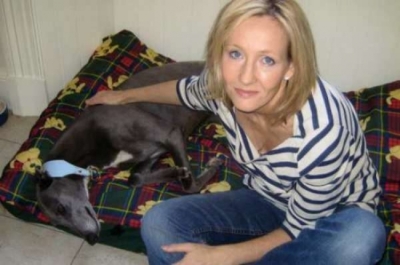
First up - staff at a small Scottish dog rescue centre were surprised when a certain J K Rowling showed up with her family, including their Jack Russell terrier, Butch. The entire clan fell in love with, and adopted, a four year old greyhound named Sapphire.


Roald Dahl was another dog fan. He’s seen here with Cookie and Amber. They also figured in his work. There’s a gorgeous poem he wrote called 'Puppy and Me'.


Dr Seuss created many mythical creatures and in real life was a true dog lover. He also  
championed many dog-related charities.


Dr. Seuss (1904-1991) Theodor Seuss Geisel — seen here with his Irish setter Cluny beside his pool in La Jolla, California

Paws and Whiskers is a special anthology of the very best stories about cats and dogs from the world of children’s literature, chosen by Battersea Cats and Dogs Home patron Jacqueline Wilson.


It’s a collection to enjoy and share for many years. For every copy sold, a significant donation will be made to Battersea Cats and Dogs Home.

Francesca Simon says:  This book is very special to me because it includes a piece about Shanti, my 
wonderful Tibetan spaniel, who very sadly died last autumn. That’s Shanti on the cover, in the 
bottom right hand corner!


It seems as though pets attach themselves to writers; most authors I know have a dog or a cat. Maybe it’s the attraction of a constant, non-critical, listener to bounce ideas off.  Whatever the reason, dogs and authors have a long and loving tradition.


R.I.P.
Reilly


The world is a sadder, darker place without my daemon.


Sharon Tregenza: www.sharontregenza.com
                              sharontregenza@gmail.com
                              facebook.com/sharontregenzabooks
                              @SharonTregenza