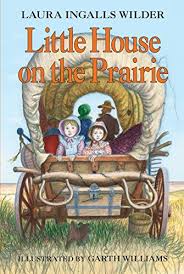
There are a lot of
classic children's books I never read as a child, many of them American. My mother had an irrational dislike of Americans (always referring to them as 'Yanks'), and all things American. American literature was banned from the house, along with peanut butter and bubblegum. (Fortunately her dislike didn't extend to films - though I never asked why, just in
case.)
The ban lasted
throughout my childhood, and included reading matter ranging from Charlotte's Web through
to the Marvel comics I craved to read as a teenager. I even remember hiding
The Great Gatsby under the bedcovers to avoid any possible argument. Over the
years I came to understand that her illogical dislike was entirely based on the American assertion that they'd won the war (which of course they had, but my
mother seemed to think Churchill did it single handedly).
Anyway, the book ban is my excuse for never having read The Little House on the Prairie until last month.

Reading classic
children's books as an adult is an interesting experience. Immediately I
recognise the beauty of the writing, and why the romance of the pioneer lifestyle was - and is - so appealing to readers. The book (and series)
is fascinating historically on many levels, as Laura Ingalls Wilder was writing
from her own experience. She actually travelled in a covered wagon, just like
in the old Westerns, and helped her father build a log cabin (she gives so much
detail, you could probably build one yourself once you've read the book).
 |
| covered wagon |
 |
| Laura Ingalls Wilder |
But there's an
underlying dark side to the story. The attitude to the First Nation peoples,
reflective of the time, makes you want to weep. From the outset, when the
family build their cabin just three miles into Indian territory (so why build
it that side of the boundary in the first place?) to the attitude of their
settler neighbours ('the only good Injun is a dead Injun'), your heart aches
for the native population, especially when you know what the future holds for
them. Even Laura's more positive childish view of them centres mainly on how
much she wants to own a real squaw baby in a papoose.
|
Yet at the same time,
the glimpses we catch of the native population through Laura's eyes are compelling -
always describing them as 'naked' when they're obviously wearing something
(particularly liked the visit to the house by two silent Indians wearing freshly culled skunk
skins - Laura's family think these 'Injuns' don't notice the awful smell,
when I strongly suspect they actually had a great sense of humour and did it deliberately).
Also the Indian camps they visit (only after the tribe has moved on) show how
well native people chose sites out of the wind, nestled in havens of wild flowers and surrounded by plenty of animals. In contrast the settlers all built their cabins too
close to the creek and ended up with malaria. The story of these pioneer
children, in their ridiculous buttoned up clothing and stifling lifestyle
(especially the women and girls), makes you yearn to know how the native
population saw them.
 |
| Laura's buttoned up family |
|
|
And this is exactly
what we find out in The Birchbark House by Louise Erdrich (thanks to SF Said
for directing me to this fantastic series of books). Erdrich provides a
compelling, beautifully written account of life as a girl in the Ojibwe tribe,
living in the Minnesota region in the mid nineteenth century. It's historical
fiction, but based on accounts from Erdrich's own Ojibwe family heritage and
her experience of living in the lands her family once inhabited. Filled with
just as much detail as the Little House on the Prairie, here we see the other
side of life in America - that of the original inhabitants.
|
From the moment the book starts, with the protagonist, Omakayas, (which translates as Little Frog)
being rescued as a baby from a village where everyone has died from smallpox,
this is a totally absorbing read. Despite the outside pressures of the white man
(chimookoman) coming ever closer into the lives of Omakayas's Ojibwe community, eventually pushing them away from their homelands, the Birchbark House series gives an uplifting and magical account of
tribal life, well researched and written from the heart. In Erdrich's own words, her books are 'in the truest sense, labours of love for my characters, my children, my ancestors, and my people.'
If
you have to make a choice whether to read Little House on the Prairie or
The Birchbark House, I'd strongly recommend the latter - but maybe that's just based on personal preference and a lifelong interest in First Nation culture.
Your best bet is to read both, and get two sides to a story that was repeated across America. You won't regret it.
Lu Hersey
blog: Lu Writes