Showing posts with label climate change. Show all posts

Friday, 9 September 2022

Writing in a climate of fear

It seems that nearly every book I write at the moment has to end with a spread about the desperate state of the world and humanity and the uncertain future that lies ahead of us. I write (mostly) children’s non-fiction with a focus on science. That means climate change, loss of biodiversity, pollution, extinction and all the other self-inflicted ills of the world are on my agenda. As we reach, and probably pass, tipping points that mean our current way of life is doomed, it’s hard to know how to present this gloomy prospect to young readers.

I can’t ignore them. You can’t write a whole book about the history of life on Earth and fail to mention that we’re heading into a major extinction event of our making. You can’t write about how Earth works as a planet and ignore the rapid climate change that will be catastrophic for many species, almost certainly including ourselves. To ignore this is dishonest and leaves the books incomplete. To acknowledge it and disarm the fear it raises is increasingly difficult, now near-impossible.

Ten years ago, I could write about all this with some hope that we might step back from the brink, do some sensible things that would at least limit the damage. Just before the pandemic I published a book which, by the time it came out, I thought already dishonest in its optimism. (Editorially imposed optimism, I would add.) Luckily, it being published the week of lockdown meant it disappeared without trace.

Book cover: Little People Big Dreams, Greta Thunberg

Hint: making bird feeders out of plastic bottles and putting on a jumper when you’re cold won’t save the planet. It might save some money, in the latest crisis to beset us. But the action we need is political and large scale, and it’s not going to come in time. If at all. The consensus is that you can’t say this to young children. But I’m beginning to wonder why not. I grew up in the Cold War, certain I’d be killed by nuclear war (still possible). My father grew up in the Second World War, certain he'd leave school to be conscripted and killed (it was over before he did). Only the people who grew up in the 90s and 00s have not done so in a climate of gloom. (That is, all the editors…) Young children know all about Greta Thunberg and climate change. She is held up to them as a hero. You can’t see someone as a hero if you don’t know what they’re being heroic about.
 
But it still leaves the problem. What to say in a book that is not specifically about the current situation, but to be complete must mention it. There is not space to go into it and its likely/possible outcomes in depth. Too much information isn’t appropriate either, as we don’t know whether the child reading the book will have someone supportive and knowledgeable to talk to.

humpback whale with calf


I’m not particularly optimistic about our prospects any more, and no longer want to pretend to be optimistic. I’ve noticed editors are no longer doing the knee-jerk ‘can we put a hopeful spin on this?’ We now recognise the ‘hopeful spin’ is just lying. The furthest I’ll go is to say humankind must do a lot of hard and urgent work, make a lot of big changes, to avert the worst outcomes. I don’t think the prospects for the planet as a whole are all that bad, unless on our way down we have a nuclear war. We’ve seen how quickly species recover once we stop killing them. Even huge whales recover quite quickly, despite having long reproductive cycles. The humpback whale population had fallen to 1000 before the moratorium on whaling, and now it’s round 25,000. Quite a bounce-back for just 40 years. Life has flourished at much higher temperatures and higher levels of carbon dioxide than we are threatening to bring. The difference is that the change is happening too quickly for things to adapt. Eventually new species will emerge to populate the hotter world. But, as in previous mass extinctions, there will likely be a few million years of desolation in which only disaster taxa like cockroaches, rats, pigeons and maybe at first a few left-over humans scavenge the detritus of civilisation. That’s not encouraging if you’re eight and want to grow up and have a fulfilling life. There’s no way of putting a positive spin on it. Perhaps the ‘we need to act fast’ line will see me through another five years before even that becomes clearly a lie. Even five years feels optimistic. As I write, a third of Pakistan is under water and California is burning. More and more young readers can see what’s happening because it’s on their doorsteps. We can’t hide it; we need to know how to talk about it.

Anne Rooney

Out now from OUP (no mention of climate change!)


Tuesday, 19 July 2022

Drops in the ocean... by Joan Haig


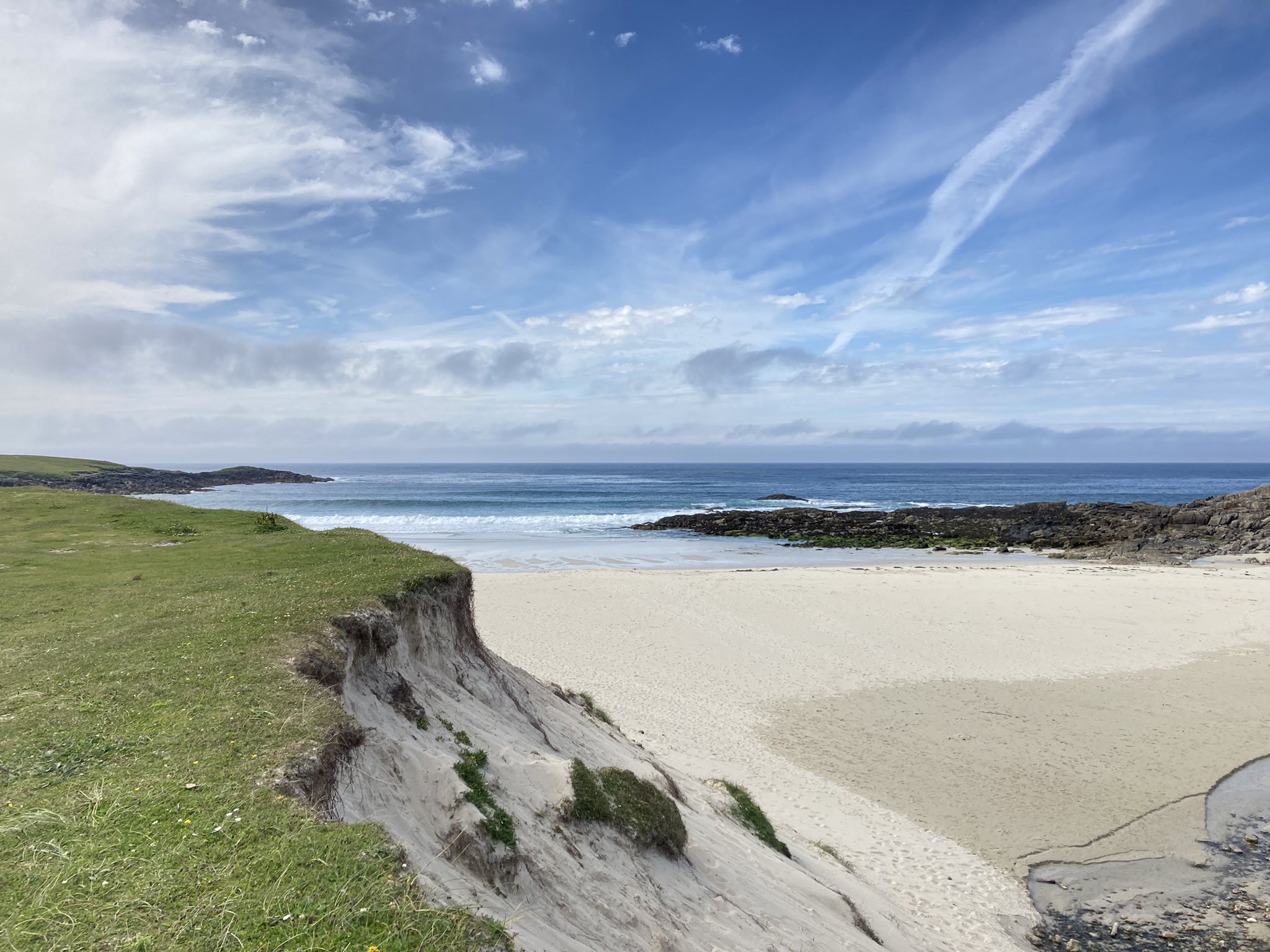
I’ve just spent a few glorious days on the Outer Hebrides. I was with two energetic eleven-year-old boys, so there was a lot more sand tunnelling and body boarding than writing and reflection.

But it’s impossible not to think about big questions when you are perched on the edge of the Atlantic Ocean. I thought about life and nature, the power of water, the universe. And I thought about colonialism and the climate crisis.

I spent formative teen years living in Vanuatu – a chain of islands in the SW Pacific that was named the New Hebrides by Europeans when they first ventured there with their trading ships and Christian missions.

While the Scottish islands are wind-battered, mostly flat and bare, Vanuatu is a tropical paradise with palm groves, volcanoes and coral reefs. But the white-sand horseshoe bays and glittering turquoise breakers make sense of the comparison between two sets of islands at opposite ends of the globe.


Image 

North Uist, the Hebrides

My current WIP is set in a fictionalised island in a hazy time setting, and the island is about to be hit by an enormous storm. But, in the real world, the story is far worse. The climate crisis is NOW.

In June I hopped on to a seminar as part of the United Nations Oceans Conference in Lisboa. The representative from Vanuatu, Christopher Bartlett, made it clear that the country needs urgent help to prevent and repair damage caused by a crisis which its population is not responsible for creating. Vanuatu has declared a Climate Emergency. Ocean acidification is destroying coral reefs. Cyclones are more frequent and less predictable. Sea rise is causing irreversible damage. In Bartlett’s heart-breaking words, “Vanuatu and our people are out of time.”

Out of time.

I thought about that line several times as we explored the puddled inlets and lochans of the Hebridean island we were holidaying on. I gave up my writing dream at university because I didn't think it was enough. I didn't think literature was powerful enough to make positive change in the world, to save the world. Stories were drops in the ocean. I know I was wrong about that; I know writing IS action. But every so often, my faith in stories falters.

On our last day we sat writing stories in the sand. Stories to be washed away and told on the tide. I hope my story will one day reach the shoreline in Vanuatu, and that it won't arrive too late to make a difference.

Thursday, 9 December 2021

When the Wind Blows harder - Anne Rooney

Rock-a-bye baby on the tree-top,
When the wind blows,
The cradle will rock.
When the bough breaks,
The cradle will fall;
And down will come baby, cradle and all.

In 1982, Raymond Briggs (of Snowman fame) published a dark graphic novel on nuclear apocalypse. The protagonists, the mature couple Hilda and Jim Bloggs, prepare themselves and their house for nuclear blast following ridiculous government advice, a thinly veiled reference to the UK government's Protect and Survive. So Jim paints the windows white and they try to buy in food to tide them over the first few pro-blast days, but they remain blissfully ignorant of what the impending disaster really means. Inevitably, their preparations are of no use. The end is bleak.

For those who don't remember the Cold War, it really did seem that the end was nigh. And the government really did promote ridiculously pointless preparations, apparently in an attempt to make people feel, if not empowered, at least not as completely powerless as they actually were. When the Wind Blows was a bold thing to do. Graphic novels were very much seen as a children's genre and Briggs very much as a children's writer/illustrator. But this is deep social commentary and truth-telling of a type that almost everyone shied away from, and not just in talking to children.  

And here we are again. I'm not alone in being incredibly frustrated at how any writing about climate crisis for children has to be sugar-coated. We can't present the truth, it's too hard to bear. We can't tell children their world is doomed on our present trajectory. We can't show what will happen if we do as little as we are doing now. We can't show them despair. So we (me too, I've followed the editorial line) water it down and present little projects like making bird feeders from old plastic bottles and posters encouraging grown-ups to do their recycling. There is some sense in this, though not enough. We don't know the circumstances of children who will be reading our books. Not all of them will have a knowledgeable adult to talk to about this, or even a reasssuring adult to give them a cuddle when they're scared. As distant authors and editors, we don't want to be responsible for despair and self-harm. Nor do we want to do nothing. And we don't want to carry on writing our 'green' books that feel increasingly like Protect and Survive. I'll let you into a secret: we know that dying your old t-shirt won't save the planet. Still, publishers don't want children to be scared.

But, frankly, scared is appropriate. People who aren't scared don't act. It's time to stop lying. Young people know what's going on with the climate. Let's say (like When the Wind Blows), 11+ is the point whent it's appropriate to remove the kid gloves. We need When the Wind Blows for climate change. It's time. I doubt Raymond Briggs, at 87, will want to do it. I'd do it (not the illustrations, obviously), though I doubt any publisher would take it on.* I spend most of my time writing about science (incuding both climate and mass extinction) and know exactly how ridiculous most of what we present on this is.  


Climate catastrophe is as terrifying a place as nuclear apocalypse. Interestingly, fiction can go there. There is plenty of climate-armageddon fiction. Fiction is doing its proper thing, inciting pity and terror. But should we be relying on fiction to educate young people about climate change? Isn't that what non-fiction is *supposed* to do? Why are non-fiction writers being locked out of the most important topic of our age? Come on, publishers, let us write honestly about the climate crisis. Let us give the background that supports the wonderful climate fiction and shows that it's not just science fiction but science and fiction — with a fast-decreasing proportion of fiction.

Like nuclear war, climate crisis makes us feel impotent. What can we individually do that will help? It's not us — the ordinary people — who can make a difference, we feel. It's not true. People persuade themselves of that because they don't want to give up their most damaging behaviours, but we've already seen how consumer pressure is pushing manufacturers to take notice at last.

The most important thing we can do, as writers, as teachers, as publishers, is to speak out honestly. Because when the bough breaks, we all fall, even the babies.


* I am proposing this to one of my publishers — the one I feel is most likely to take something risky. We'll see how it goes

All images except Protect and Survive from When the Wind Blows, Raymond Briggs, 1982. Used without permission, but in a good cause

Anne Rooney

 Latest book:


Lonely Planet, The Dinosaur Book, 2021


Sunday, 11 October 2020

Tales from a life without technology (kinda) - Kelly McCaughrain

Recently I read The Way Home by Mark Boyle, in which he describes his attempt to live without technology. The book is fascinating but I was particularly interested in his experience of writing without technology. 


He freely admits ‘technology’ is a woolly term that you have to define for yourself. Technically, language and pens can be described as technologies. But he did rule out electricity, which meant no laptop. He didn’t have a typewriter either. So it was back to pencils and paper to produce the book, plus his journalism on the subject, which he had to post to his editors, who also had to write letters to him since he didn’t have a phone. It took about a month to get an article published. Imagine a newspaper editor waiting a month for your article these days!

He said writing on paper is a process his generation (he’s about 40) has little experience of. He’d never tried to write anything without a computer and quickly realised it requires a different approach. We tend to vomit-draft our ideas on computer and then edit them, using the screen as an extension of our thinking process. But Boyle found he started to think for a lot longer before setting any words down, getting his ideas in order and knowing what he wanted to say before he said it. 

Mark Boyle

He said the paper he was using was cheap, but not cheap enough, because if he’d had to make his own paper, he’d have been even more careful about what he wrote.

When it came to the book being published, he had to use technology, and he elected to type up the manuscript himself. Which he soon regretted because he found staring at a screen for hours left him tired in a way that growing food, tending animals, chopping wood and the million other physical tasks involved in self-sufficiency did not. It was a different class of tiredness and a much less pleasant one. 

Mark's technology-free house. I'd live here.

I had great plans to write this blog post on paper, to test this theory, but in the end I ran out of time. And maybe even put it off because the idea was just so daunting. And it’s just a blog post! How on earth did Jane Austen write her novels? With a pen she had to stop to dunk in ink every few words! 


Anyway, the book is about our reliance on technology and the environmental impact of that. I think that we probably believe that we’re actively saving the planet when we send emails and use phone calls instead of posting letters, and when we draft on a computer instead of printing out reams of paper. We have this idea that computers and phones are carbon-neutral because they don’t produce anything we can hold in our hands and send to landfill.  

But my software engineer husband assures me we are deluded and proceeded to educate me on a lot of techy stuff I had no idea about. Namely:

Think about this – how many new smartphones have you had in the last decade or so? Probably a new one every couple of years when your contract runs out. And you had to upgrade, not only because you smashed your screen, but because your old one had started to run slowly, run out of memory and kept telling you to delete your photos. 


But does your latest smartphone actually do anything that your first one didn’t? You’re running the same apps (Facebook, Twitter, Email, Instagram, Whatsapp, Music Player, Camera), nothing significantly different. And your new phone has a vastly bigger memory than your first one. And yet it’s getting slower and slower. 

I think most people assume that their phone is somehow aging. Slowing down like a tired OAP who suddenly can’t cope with the things it used to. 


This is a big fat lie!

Phones do not deteriorate like this (though batteries do a bit) and they don’t lose their memories like someone with dementia. What is actually happening is this: Lazy programming.

Every time your phone insists that you ‘install upgrades’ or Facebook etc releases a shiny new improved version (like this really annoying Blogger one), these upgrades eat up more of your phone’s capacity to do stuff. The upgrades give you only slightly better features, but the programmers know that you’re using a better phone than you were last year, with more memory on it, so they don’t have to be as tidy with their software. They can sprawl out in that extra memory space and take up twice the room to do pretty much the same stuff. 


They might also be incorporating features that your old phone doesn’t have, such as multiple cameras, but often it’s just that it takes effort and elegant programming to make a program run on less memory, and why should Apple software care about making your phone function well for longer when you’ll be replacing it with an expensive new Apple phone?

All this goes for computers and laptops too. Your laptop is not running slow because it’s old, it’s running slow because the software is demanding more and more processing capacity.

And so we toss millions of pieces of perfectly good technology into landfill every year.

And all those online interactions are not carbon neutral. Every click has a cost and they require a physical infrastructure. They have to be processed by ‘server farms’, which are power-hungry and generate huge amounts of waste heat which has to be cooled using vast quantities of water, often in dry regions where water is scarce. Google are now storing their servers deep under the sea to keep them cool, or building them near coasts so they can use seawater as a coolant.

I don’t know enough about the eco-impact of that to comment, and I’m definitely not an expert on all this so if you’re interested I suggest you go and read more about it, but I just wanted to point out that, while we’re all becoming much more eco-aware, there are unseen costs to our technology use that never get mentioned.

In his book, Mark Boyle says he used to describe himself as an ‘environmentalist’ but he doesn’t anymore, because it seems to him that ‘environmentalism’ has become all about finding ways to maintain our over-consumptive lifestyles in ways that harm the earth a bit less, rather than about changing the way we live so we're more in harmony with the earth. It’s all about energy-saving lightbulbs rather than just switching the lights off and not over-illuminating our cities. It’s about electric transport, rather than suggesting we walk occasionally. 


Just to illustrate the point, I’ve just witnessed a neighbour take a heavy-duty power tool to a new hedge that could honestly have been trimmed with a pair of nail scissors. How often do we take the low-tech option these days? Even our shopping lists are on apps instead of the backs of envelopes. When my husband’s upstairs I phone him or text him rather than get off the sofa and go talk to him. 

I am not about to give up technology, but it was interesting to read about someone who did, and who was forced to think about what technology is worth keeping, what technology you can do without, and what technology life is actually better without. 

I think we are reliant on technology in ways we aren’t even aware of, and maybe it’s no healthier for us than it is for the environment. Maybe the healthy solution to climate change isn’t to harness enough wave and solar power to enable us to be more and more productive, stare at screens all day, and go to bed brain-dead and drained. Every click has an energy cost, and maybe not just to the planet but for us too. 


Kelly McCaughrain is the author of the Children's Books Ireland Book of the Year,
Flying Tips for Flightless Birds

She is the Children's Writing Fellow for Northern Ireland #CWFNI

She also blogs at The Blank Page

@KMcCaughrain